Why go
Where the Dairy Belt Still Holds
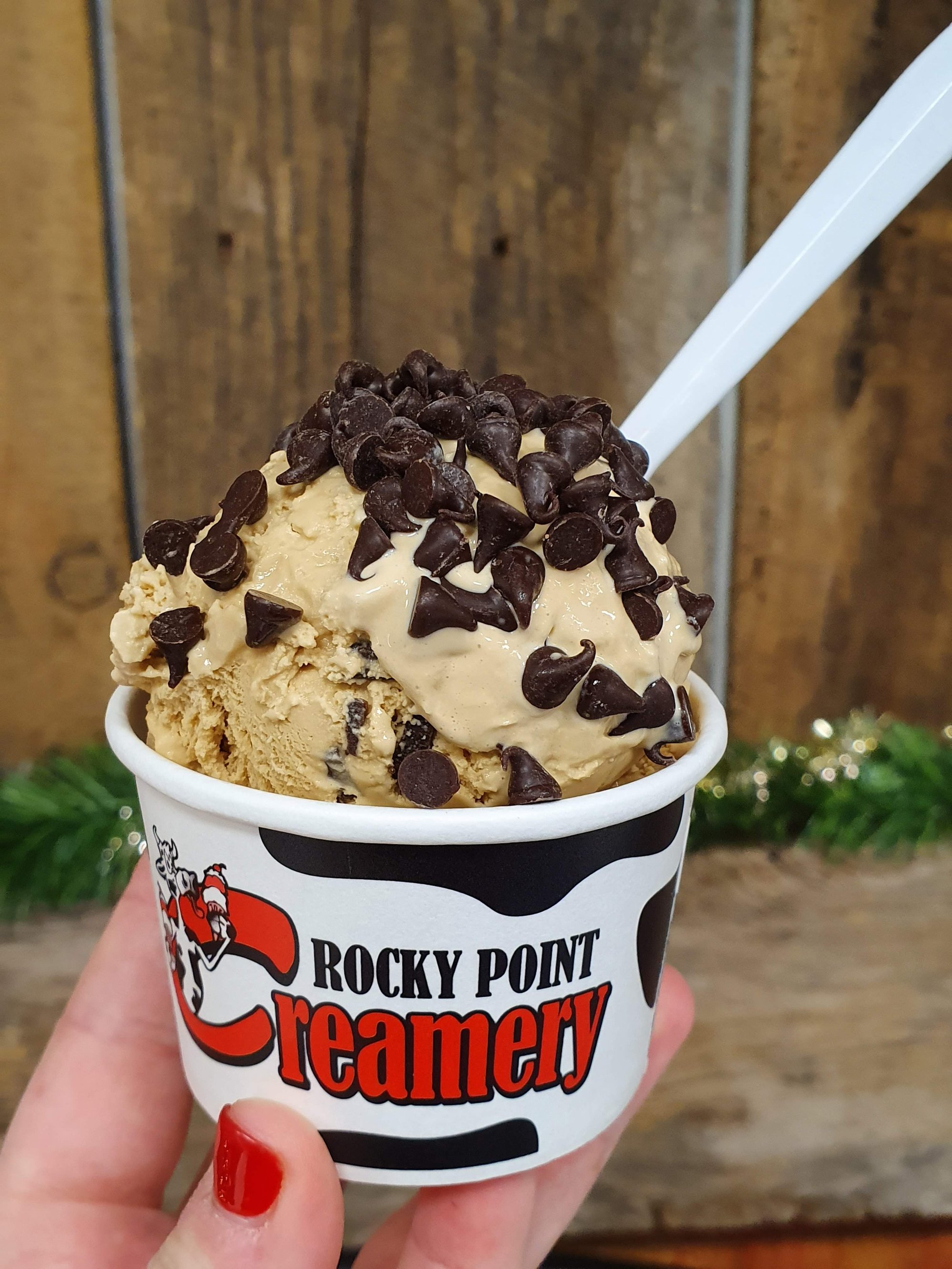
The stretch of Tuscarora Road running through the Point of Rocks and Tuscarora corridor in western Frederick County looks much the same as it did several generations ago. Farmland presses close to the road, silos interrupt flat sightlines, and the pace of change is slower than in the suburbs that have been climbing steadily westward from the Washington metro. It is in this context that Rocky Point Creamery at 4323 Tuscarora Road belongs: a production-rooted dairy enterprise that exists because the land around it still supports that kind of operation. For the growing tier of American food travelers who treat ingredient provenance as the primary editorial lens, this corner of Maryland rewards close attention.
The Sourcing Logic of Small-Scale Creameries
American dairy has split into two largely disconnected tiers over the past two decades. At the commodity end, consolidation has reduced the number of independent farms dramatically while increasing volume per operation. At the other end, a smaller cohort of creameries has moved toward defined-origin milk, short supply chains, and formats that collapse the distance between animal and product. Rocky Point Creamery belongs to this second category by geography and operational scale. Frederick County, Maryland is not a marketing identity in the way that Vermont or Sonoma might be, but it carries its own agricultural credibility: the county has one of the highest concentrations of working farms on the Eastern Seaboard, and the Monocacy Valley soil that defines much of this terrain has supported dairy for well over a century.
The argument for sourcing dairy from operations at this scale rests on a direct logic. When milk travels a short distance between production and processing, the variables a cheesemaker or creamery operator can control expand considerably. Temperature consistency, processing timing, and the seasonal character of the milk itself all become more legible when the supply chain is local and transparent. This is the underlying premise that separates a small Frederick County creamery from a regional distributor, and it is the same premise that has driven the broader American artisan cheese revival that accelerated through the 2010s and continues to influence how serious food travelers approach dairy destinations.
What Small-Format Creameries Actually Produce
The product range at creameries operating at this scale typically maps to the capabilities of their processing setup and the volume of milk available. Ice cream, fresh dairy, and soft or semi-soft cheeses are the natural outputs of operations that cannot sustain the long aging programs required by harder formats. These are not lesser products for that reason. Fresh dairy and frozen formats made from locally sourced milk with a short chain between production and sale carry a sensory directness that is difficult to replicate at industrial scale. The fat content, the seasonal variation in flavor, and the texture of the final product all reflect the milk's origin in ways that commodity processing actively works to standardize away.
This matters as a point of comparison for anyone who has eaten at restaurants where ingredient sourcing is treated as central rather than incidental. Places like Blue Hill at Stone Barns in Tarrytown or Single Thread Farm in Healdsburg have built their reputations in part on the argument that the distance between source and plate changes what ends up on the plate. The same logic applies at the production level. A creamery that sources locally is not making the same product as one that sources from a consolidated pool, even if the format is identical.
The Western Maryland Farm Corridor in Context
Frederick County sits at an interesting intersection within the broader Mid-Atlantic food geography. It is close enough to Washington, D.C. to draw informed urban food travelers, yet far enough removed from the capital's density that agricultural land use has remained economically viable at a scale that has disappeared from closer-in counties. This creates conditions where the farm-to-table premise is not a marketing retrofit but an operational reality. Operations like Rocky Point Creamery exist because the land supports them, not because a branding exercise demanded them.
The comparison set for serious food travel in the region spans a wide price and format range. At the high end, The Inn at Little Washington and Causa in Washington, D.C. represent the formal dining tier where sourcing credentials are interrogated closely. Further afield, Le Bernardin in New York City, Atomix in New York City, Alinea in Chicago, Lazy Bear in San Francisco, The French Laundry in Napa, Providence in Los Angeles, Addison in San Diego, Bacchanalia in Atlanta, Brutø in Denver, Frasca Food and Wine in Boulder, ITAMAE in Miami, Emeril's in New Orleans, and 8 1/2 Otto e Mezzo Bombana in Hong Kong each operate at price points and formats that share little with a rural Maryland creamery in practical terms, but the sourcing conversation that animates the finest of them runs through the same argument. Where the ingredient comes from shapes what you eat. Rocky Point Creamery makes that argument at a direct, production level, without the intermediating layer of a restaurant.
Planning a Visit
Tuscarora Road is accessible from Route 15 heading north out of Frederick, placing the creamery within roughly an hour's drive of both central Washington and northern Virginia. Hours are Tuesday through Sunday, 11:30 AM to 8:30 PM, with Monday closed. The creamery is walk-in friendly and open Tuesday through Sunday, 11:30 AM to 8:30 PM.